How One Fire TV Stick Became FTVDB
How a Fire TV Stick led from unreliable updates and logcat URLs to FTVDB, a community index of public Amazon device update metadata.
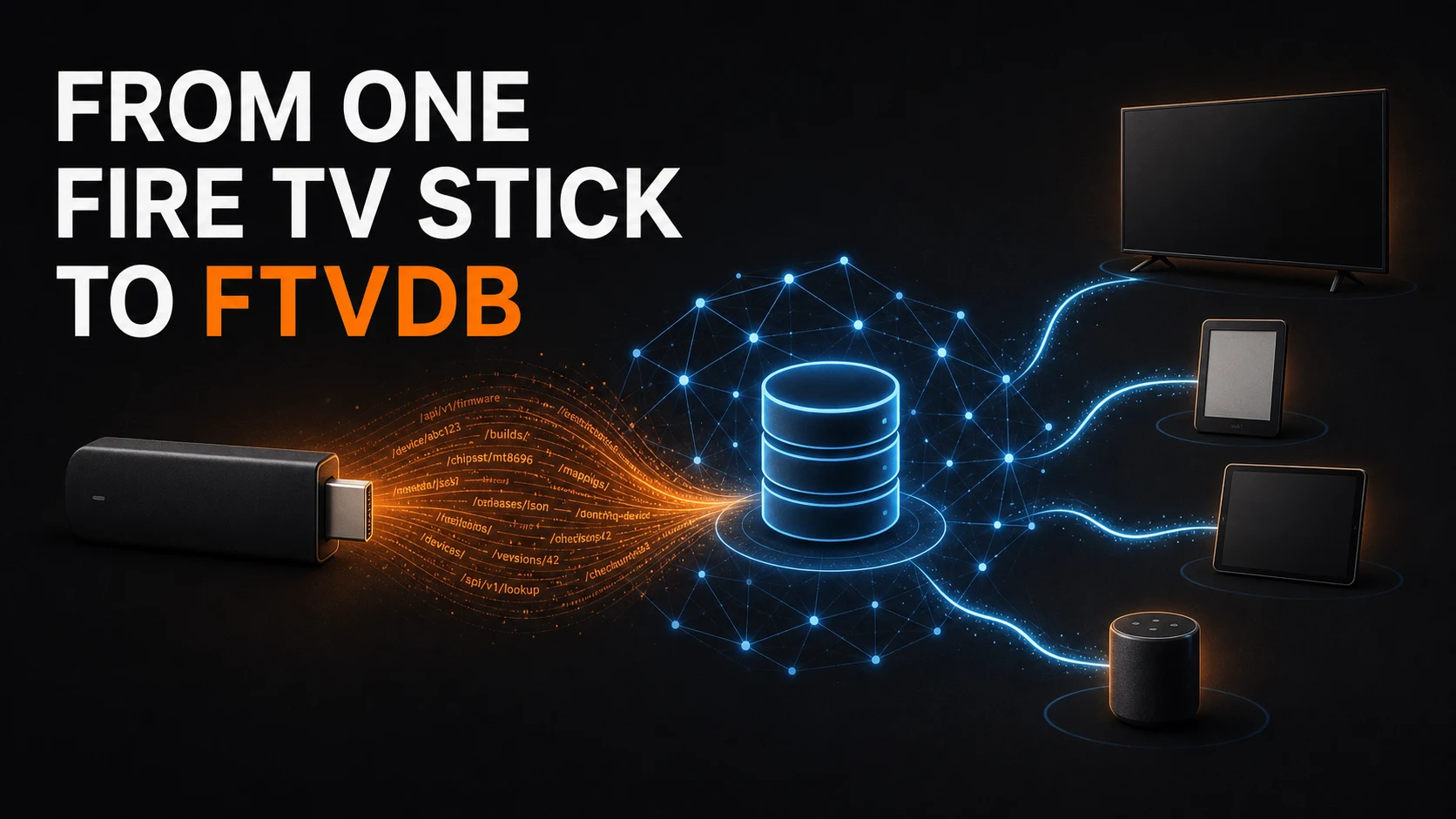
In 2019, during my first visit to New York, I was amazed that Amazon could deliver an order the next day. I wanted to try it, so I bought a Fire TV Stick 4K. I expected an ordinary streaming device. Instead, that purchase started a project I would still be developing years later.
At home, I was using two HDMI sticks. A Roku handled streaming apps, while an EzCast 4K let me send things to the television through AirPlay. The Fire TV supported the apps I wanted, and I found an AirPlay server for it. One device could replace both sticks.
Android has never been my favorite operating system, but its flexibility was hard to ignore. Once I saw how far the Fire TV could be pushed beyond Amazon’s out-of-the-box experience, curiosity took over.
A note before continuing
This is the story of experiments performed on a device I owned. It does not reproduce step-by-step instructions for rooting hardware or bypassing security.
The update problem I created for myself
I rooted the device with the Fire TV version of Kamakiri, published and documented by XDA developer k4y0z. Kamakiri automatically installed TWRP, a custom recovery environment, as part of the process. With root and SSH access, every answer revealed another part of the system worth exploring, and the experiment quickly consumed the rest of my evening.
Root access also created the problem that eventually led to FTVDB. Regular over-the-air updates and full system updates were no longer reliable, so I had to handle updates manually. That pushed me toward the system logs.
Android’s logcat output exposed public, unauthenticated source URLs on Amazon’s servers for firmware updates, applications, and other system components. The challenge was capturing the correct URL for a particular device and version while it was visible.
My goal was not to redistribute Amazon’s files. I needed a dependable record of where an update had appeared and what it belonged to. That meant keeping the device family, model, build, software version, checksum, and date whenever those details were available. A URL could solve the immediate problem and then disappear into terminal history. Without its context, it was little more than an unreadable string.
The first database was a Pastebin
In April 2020, I began collecting those URLs on a Pastebin page and formatting them as a table. The page now only points readers to the project’s newer home, but there was no website, API, or formal database at the time. It was only a reference for myself until people began mentioning it on XDA Developers. That was when I realized my notes were helping people I did not know.
Pastebin was enough to prove the idea, but it was not a good long-term home. Every addition required manual editing, and the presentation was mixed together with the data. As the table grew, it became easier to make a formatting mistake or place a record in the wrong section.
Turning the table into structured data
I moved the list to a GitHub Gist. The Gist gave the project a better public history and made revisions easier to follow, but I was still maintaining a large human-readable table.
The next step was a command-line tool that generated the table from structured records. The generator turned the project from a document into a small data pipeline. Records were now separate from their presentation, so I could keep the fields consistently structured, regenerate the table, and correct one source record without rebuilding the surrounding text.
The Gist went through many revisions as new devices and updates appeared. Other enthusiasts began publishing similar tables, confirming that the need extended beyond my own list. Even so, every update still depended on me noticing it, capturing it, and finding time to publish it.
The project outgrew one person
By early 2025, I was using Fire TV devices less often, had other work demanding my attention, and was missing new URLs. The list could stay current only when I happened to capture and publish each update. I could either watch it become outdated or give other people a way to contribute without turning the database into a disorganized collection of links.
Around that time, I discovered that ftvdb.com was available. The name was short, clear, and matched what the project had already become. I registered the domain and began turning the old list into FTVDB.
The new goal was larger than publishing another version of the table. I wanted a searchable website, a documented submission method, automatic validation, an open database, and a publishing system that would not require me to hand-edit every page.
Building a web project around C++
C++ is familiar territory for me. Web design is not. I used Codex to help develop the website and refine its presentation, while I designed the architecture and built the backend as several C++ services. Each service is responsible for one part of the workflow.
- The submission service accepts a public update URL.
- The validation process checks the URL and the information that can be derived from it.
- The records are normalized and organized by device family, model, build, and version.
- A generator publishes the reviewed data to GitHub.
- The website is updated from the same reviewed records.
When a submission uses a URL pattern that has not been tested before, the system sends it to a manual review queue instead of publishing it automatically. I periodically inspect that queue and decide whether each unfamiliar pattern can be accepted into the database.
The website is one way to browse the information, but the FTVDB public database also provides JSON records that developers and researchers can inspect or use independently.
People can contribute through the submission page or the documented submission API. A submission contains one public URL, and FTVDB does not log the submitter’s identity.
I still maintain the system and review its direction, but discovering every update no longer depends on my own devices or schedule.
How the community expanded FTVDB
When I launched FTVDB, it covered Fire TV devices only. Its name described its entire scope, and I had designed the database and website around the hardware I already knew.
The first major community contributions came from R0rt1z2, a researcher known for work on MediaTek bootloaders and Amazon devices. After contributing many Fire TV links, he told me that he also had update links for Amazon Echo and Fire tablets.
My answer was simple. “Why not?”
Supporting those devices required another redesign. A new family could not be added by placing a different label on an existing record. Both the data model and the website had to understand what kind of device each record described.
Kindle support came later, after conversations with scam.net and notmarek, both active in the Kindle jailbreaking community. Scam.net is credited with the concept and discovery behind WinterBreak2. Notmarek created LanguageBreak, a jailbreak for Kindle firmware 5.16.2.1.1 and earlier, along with other Kindle tools.
Our conversations showed me that Kindle owners faced the same problem as Fire TV owners. Scam.net and notmarek donated many old Kindle firmware URLs, giving FTVDB a historical foundation that could not be reconstructed from a page containing only the newest releases. Supporting Kindle meant extending the database and website so its models, generations, firmware versions, and links could be organized as their own device family.
For newer releases, FTVDB collects links from Amazon’s official Kindle E-Reader Software Updates page, which lists the latest firmware available for each supported model. As Amazon updates that page, FTVDB can preserve the public URLs as part of a longer history.
Skel40, an active member of the Fire TV community on XDA Developers, contributed Fire TV Stick Lite links. Other contributors are recognized on FTVDB’s credits page, while many more chose to remain anonymous. I respect that choice. Their records are no less valuable because there is no public name beside them.
One collector did not want their links included in FTVDB. I respected that request, excluded the records, and added safeguards to prevent them from being added through other submissions. The collector also asked not to be named, so I will not identify them here. I hope that one day we can combine our efforts, merge the collections, and make the database more complete for everyone.
Some contributors told me they were happy to finally have one place where the links were organized and easy to find instead of scattered across forum posts, logs, and personal lists. Feedback like that motivates me to keep improving the service.
FTVDB now covers Fire TV, Kindle, Echo, and Fire tablet devices, including more regional variants and software generations than any single collector is likely to encounter. Its name still comes from the first family it covered, while the contribution manual explains how people can help preserve records across its much broader scope.
Why FTVDB indexes metadata instead of files
FTVDB records public source URLs and their metadata. It does not mirror, host, or distribute firmware, system components, or application packages. The files remain on the servers where their publishers placed them.
FTVDB is meant to document update history. An organized record can help someone recover a device, locate an appropriate official update, compare software history, or research how a product changed. It can also remain useful if a page, forum post, or personal list disappears.
FTVDB is an independent project and is not affiliated with Amazon.
Why indexing is different from exploiting a device
I do not know whether Amazon has an opinion about FTVDB, and I do not speak for the company. What I can explain is why I see an index of public update locations as different from publishing an exploit.
Amazon patches vulnerabilities that make jailbreaks possible. The LanguageBreak documentation, for example, warns that newer Kindle firmware patched the method it used. I think user and account security is one important reason for patching these vulnerabilities. A Fire TV is not only a television interface. It connects to Amazon services and supports purchases through Amazon’s platform. Unauthorized code execution may therefore affect more than device customization.
FTVDB is not a jailbreak. A public update URL does not exploit a device, install anything, or make a stock device accept older firmware. It identifies a package that Amazon made accessible without an account or authentication.
These links are useful to people who already have the access required to work with a modified device. They can also help experienced owners repair a device with current official firmware. Based on that distinction, I do not see the database itself creating a meaningful privacy or account-security risk. That is my own assessment, not a statement or endorsement from Amazon.
Amazon still controls the servers and every file FTVDB indexes. It could replace all of those URLs at once, restrict access, or remove the files, invalidating much of the database. Amazon has not done that during the years I have maintained these records, but continued availability is not approval. FTVDB works only while Amazon keeps those locations accessible.
A project I intend to keep free
I have earned no income from FTVDB, and I have no plans to monetize the database itself. The records are released under the MIT License and can be used free of charge under that license.
I built it because I needed the information myself, not because I saw a business opportunity. I enjoy creating things that are useful to me and to the community. Knowing that someone can now find a link in one place instead of repeating a search that took me hours is enough reason to keep going.
What this project taught me
Each version of FTVDB exposed the next problem I needed to solve. The original table taught me which details mattered. The generator separated the records from their presentation. Community submissions forced me to build validation and review into the workflow. If I had tried to design the final system in 2020, I probably would have built the wrong thing.
The lasting challenge was not simply collecting more URLs. It was making it easy to contribute while keeping every published record organized and trustworthy.
I bought the original Fire TV Stick because next-day delivery in New York felt exciting. It later replaced two devices connected to my television. Years after that, the same purchase became a C++ backend, a website, an open database, and a growing record of public update metadata for several Amazon device families.
You can browse FTVDB, inspect its open database on GitHub, or help preserve another record through the submission page.