Why Some App Store Developers Skip Free Trials
For some one-time-purchase iPhone and Mac apps, adding a free trial can weaken App Store discovery and complicate institutional volume sales.
Last updated
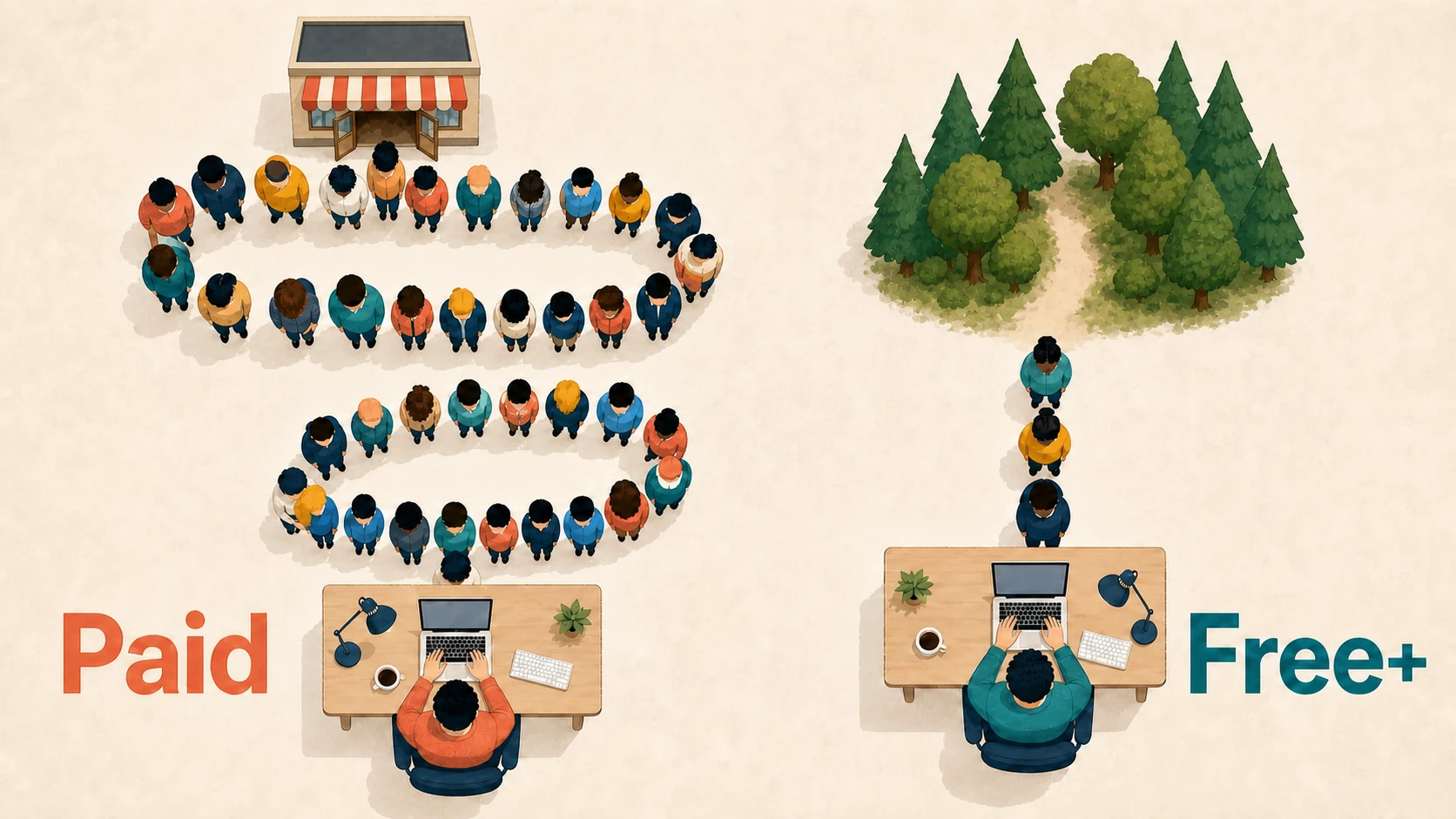
Free trials are better for customers. They reduce the risk of a bad purchase and give an unfamiliar developer a chance to earn trust. So why do some App Store developers still charge before download?
For one-time-purchase apps, the answer can be more complicated than unwillingness to let people try the product. In my experience with my own iPhone and Mac apps in the US storefront, adding a trial can move an app into a much more competitive chart. It can also make the complete app harder for a school or business to buy in volume.
A trial changes which chart the app can enter
The same utility can be sold in three ways.
| Business model | Download price | Final payment | App Store chart |
|---|---|---|---|
| Paid upfront | $9.99 | One time | Paid |
| Free trial with lifetime unlock | Free | $9.99 one-time in-app purchase | Free |
| Free trial with subscription | Free | Recurring in-app purchase | Free |
Apple gives auto-renewable subscriptions a built-in free-trial introductory offer. For non-subscription apps, the App Review Guidelines allow a time-based trial through a zero-priced non-consumable in-app purchase before presenting a full unlock.
Apple does not offer an equivalent try-before-you-pay entitlement for an app whose download itself has an upfront price. To let someone evaluate a one-time-purchase app before paying, the developer normally makes the initial download free and sells the permanent unlock inside the app.
That choice changes the chart. Apple's public iPhone charts and Mac charts are split into Free and Paid rankings. A free app with a lifetime unlock competes in Free. A paid-upfront app competes in Paid. The charts separate them by initial download price, not by whether the customer ultimately makes one payment.
The US Top 200 shows how large the difference can be
Every first-hand result here comes from apps I have built and is limited to the US storefront. Other categories, countries, and periods may behave differently.
In the native App Store, the full scrollable category chart exposes 200 positions. An app inside that range can be found by someone browsing the category. Below it, the category rank disappears and there is no next row to reach.
Installing a free app requires no purchase decision. The Free charts can therefore contain products drawing far more downloads than a small paid utility, including apps funded by subscriptions, advertising, commerce, or businesses outside the app itself.
For my paid apps, I have observed even a single purchase move an app toward the Top 200 Paid chart. I have also seen one of my free apps receive tens of first-time downloads per day and remain outside the Top 200 Free chart.
Apple does not publish its thresholds or complete ranking algorithm, so this is not a formula. It shows how different the two competitive pools can be. Moving from Paid to Free can take a small utility from a chart it can enter to one in which it has no visible position.
App Store Connect supports the connection. Apple defines App Store Browse as discovery while someone explores sections of the store. For my apps, higher chart positions have coincided with more Browse impressions, downloads, and sales.
An app outside the Top 200 can still be found through search, advertising, editorial features, recommendations, or external links. What it loses is category browsing. A trial may improve conversion and trust, but it can also make a small developer more dependent on those other acquisition channels.
Institutions can buy app licenses, not bulk IAP unlocks
Individual customers are not the only market. Apple says public App Store apps are automatically available for volume purchase through Apple Business and Apple School Manager. Organizations can buy licenses, assign them to users or devices, and distribute the app through device management.
These are not necessarily small orders. Apple's Apple School Manager purchasing guide explains how organizations can obtain thousands of licenses at once. A single decision can therefore represent a substantial sale.
An in-app purchase does not fit that purchasing flow. Apple says in-app purchases cannot be bought as standalone content and distributed through Apps and Books. End users can make and restore in-app purchases in apps assigned to users, but device-assigned apps do not support IAP. The important limitation is that an institution cannot centrally buy 2,000 copies of a lifetime unlock and assign them the way it can buy and assign 2,000 paid app licenses.
For a developer selling to schools or businesses, a free download with a one-time IAP may work for individuals yet fail the organization's procurement and deployment requirements.
One solution is to keep the public app paid upfront. Another is to offer a separate full-featured Custom App for specified organizations, but that adds another product to distribute and maintain.
The point is not whether institutional orders affect chart rank. Paid upfront preserves a purchasing channel where one decision can represent hundreds or thousands of seats.
The pressure is harder to escape on iPhone
A Mac developer can avoid this tradeoff by distributing a Developer ID build directly with a flexible trial and one-time license. That requires handling payments, licensing, updates, and support outside the store.
iPhone developers do not have an equivalent worldwide route. Alternative iPhone distribution exists in certain regions, but it is not a global replacement for the App Store. The chart tradeoff is therefore harder to escape on iPhone.
What Apple should change
Apple could solve the central problem with a native trial entitlement for paid apps. The product page could keep its price and Paid chart classification while allowing a clearly limited evaluation before purchase. Institutions could continue buying and assigning licenses in volume.
Another option would classify discovery by the eventual business model. A free-download app funded by one non-consumable lifetime unlock could compete with other one-time-purchase apps instead of subscription services and completely free products.
Apple could also let organizations buy and assign non-consumable lifetime unlocks through Apps and Books. That would remove the procurement disadvantage for developers who want to offer a free download with a one-time purchase.
Users are right to want trials, and developers should explain pricing clearly. But when a trial can replace reachable Paid chart visibility with an unreachable Free chart and replace a volume-purchasable app with an unlock institutions cannot distribute, charging before download may be commercially safer.
The missing trial is not always the developer's preference. Sometimes it reflects incentives Apple created across discovery and procurement. If Apple wants more trials, it should stop making small developers risk those sales channels to offer one.