How Facebook and Telegram Are Destroying Businesses
Facebook deleted my work, ignored a scammer using my old page address, and accused me of impersonating my own project. Telegram stole my project's username and is trying to sell it back to me.
I’ve been building software since 2008, making projects that people find useful and enjoy using. In 2013, I started my first public open source project, Qt Bitcoin Trader. I hosted it on SourceForge because I couldn’t afford a domain name.
The app became popular quickly, and scammers noticed. They registered a .com domain with the same name as my app and put malware there. Someone looking for my software could download the malware thinking it was my app.
The code was public, so anyone could change it and release their own version. I wanted users to know which downloads really came from me.
I got the domain taken down by reporting it for phishing. I still don’t know how many people were affected. That really upset me. People were looking for my software, and they might have ended up with malware instead. I didn’t want that to happen again.
One year later I took control of that domain and kept it reserved for Qt Bitcoin Trader to protect my users from scammers.
Since then, whenever I start a new project, I reserve its domain name and social media addresses early. I do that to protect the people who use my software. I want them to find me before a scammer gets there first.
Over time, more people who liked my work started following my Facebook pages and Telegram channels. I posted project news there and got feedback in the comments. It was easy and fun to talk to the people using my software.
I ended up relying on those pages and channels for all my project news. I had no email subscriber list and didn’t send updates by email. I trusted Facebook and Telegram to keep everyone who followed my work in one place and get my messages to them.
My page with over 25,000 subscribers disappeared
One of my other projects had a Facebook page with over 25,000 subscribers. I was happy to have so many people following my work, and they enjoyed reading the posts.
Then one day the page was gone. There was no message, no warning, and no option to appeal. I contacted support, but they kept sending me back and forth without explaining what had happened.
My last post had included an iPhone photo copied from Apple. I suspected that it had caused a copyright problem, but Facebook never confirmed that. I would have removed the image if they had asked. Instead, I lost the whole page without a chance to fix anything.
I took it as a lesson to stop posting images I didn’t own. I created another page, which is still live today. I couldn’t use the same Facebook address, so I accepted the new one and moved on. I thought the old address would at least stay reserved so nobody else could use it.
A few months later, I opened the old address and found someone else’s page there. It looked like my project’s page, but it asked people to contact an email address that wasn’t mine. It even linked to my real website as if the person running the page owned it.
People had already shared my old page address all over the internet. Those links were now sending people to a scammer, who gained thousands of subscribers from the work I had done to build that page.
I reported the impersonation many times. My original page was already gone, and I never got an answer to those reports. I have no idea how many people were affected. The fake page is still live and sharing false information about my project. That’s why I won’t name the project or link to the page here. I don’t want to send the scammer more people.
Then Facebook accused me of impersonating my own project
A few years after losing that page, Facebook also suspended the Qt Bitcoin Trader page.
Its Facebook page had people who had followed my work for more than a decade. They were waiting for updates to software they used. Facebook was the only place where I had built a subscriber list for this project.
I had been busy with another project and hadn’t posted for a few months. One day I switched to the Qt Bitcoin Trader page to check for new comments. Instead, I saw this message.
“We suspended your Page. This is because Qt Bitcoin Trader goes against our Community Standards.”
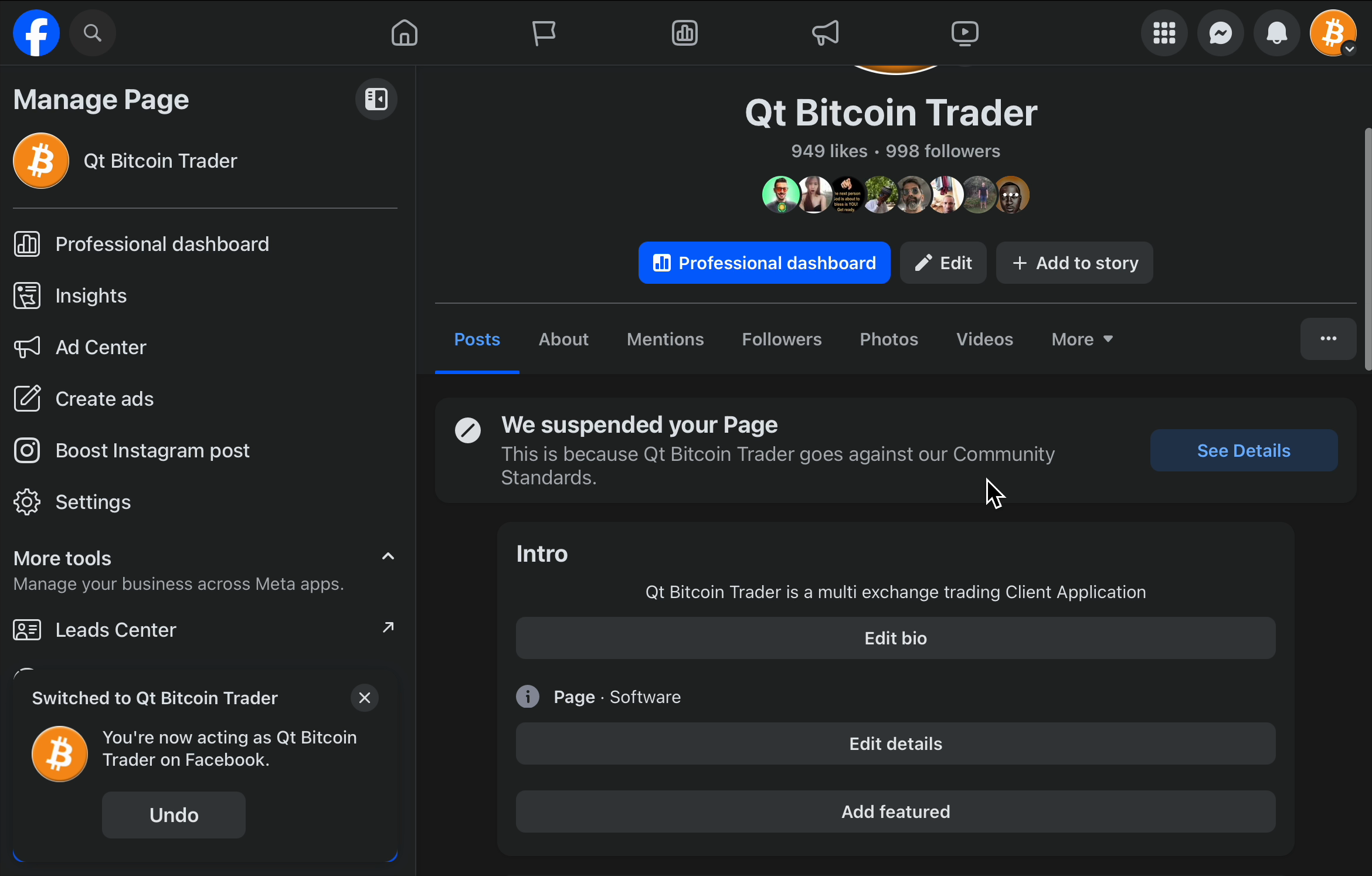
I couldn’t understand it. This was my own project. I hadn’t posted any Apple images, and I hadn’t posted anything at all for months. I tried to appeal, but the button didn’t get me anywhere.
The page said I had seven days left to request a review. I was worried about losing it, so I contacted support straight away.
Seven days to appeal, and a button that didn’t work
After a long conversation, support told me that my page was impersonating someone else. I had created the software and run its official page for years. I had no idea how they could call that impersonation.
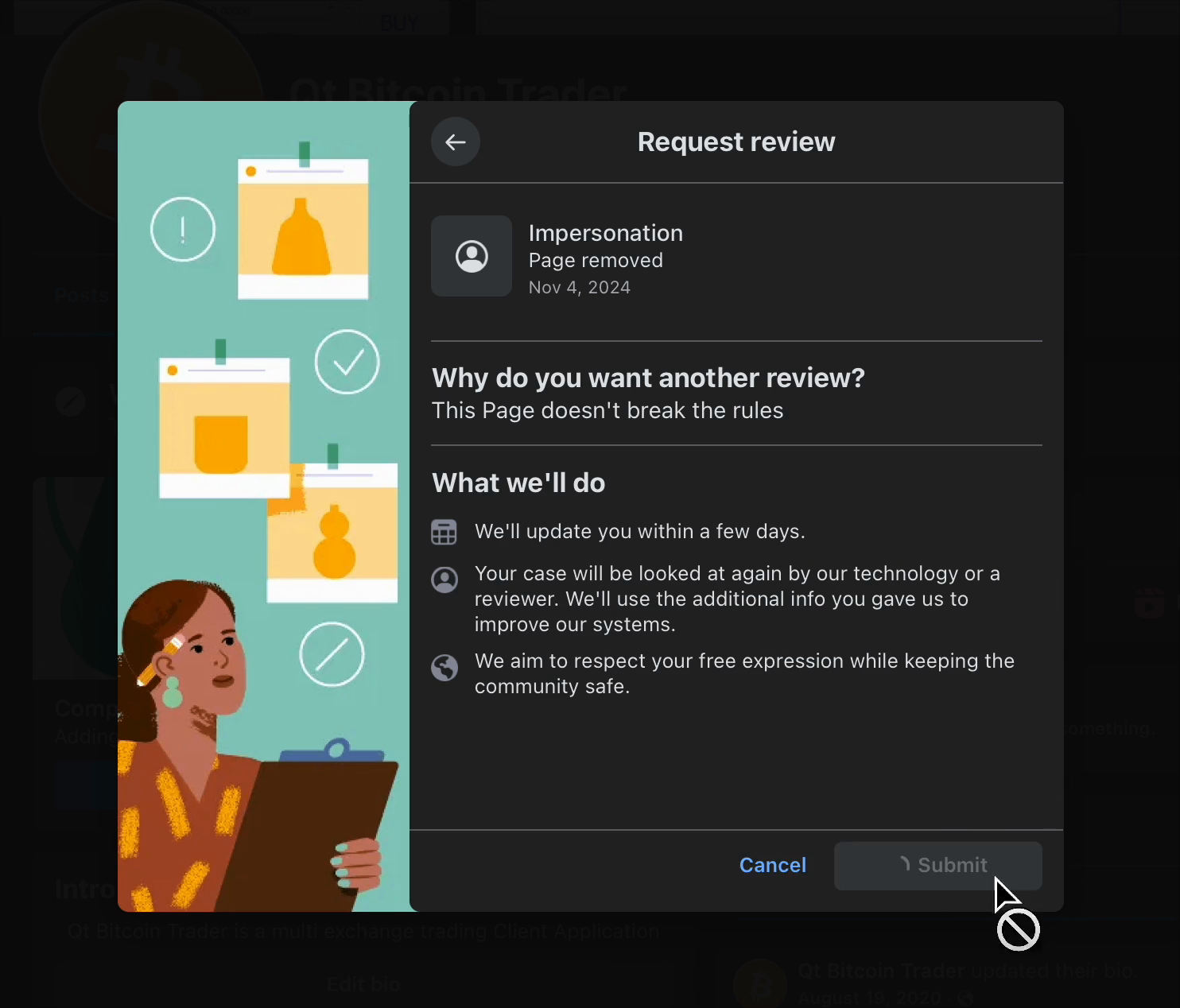
They told me to try the appeal button again later. I tried it on every device I had. I still couldn’t submit an appeal. I contacted support again and got the same answer. Try again later, and it would work.
It didn’t. I recorded some of my attempts. In the review form, I could select “This Page doesn’t break the rules”, but pressing Submit left it loading. Facebook promised an update within a few days while I couldn’t even get the request through.
With just one day left, support finally passed my case to someone else. I sent documents going back to 2013 to prove that I was the owner and creator of Qt Bitcoin Trader.
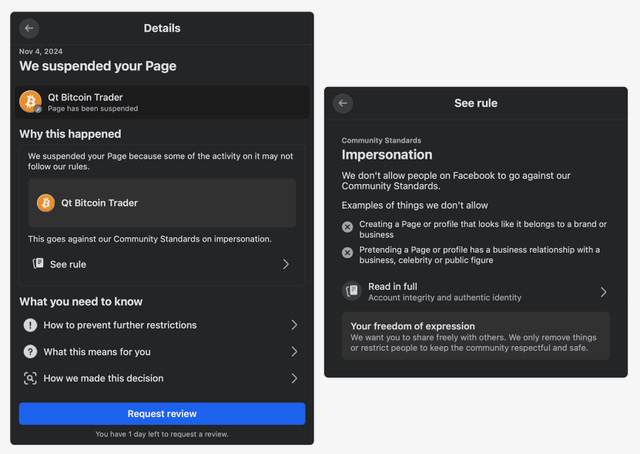
The answer was still that my page was impersonating someone else. The documents didn’t help, and I couldn’t get a reasonable explanation.
I went back to the support person who had passed my case on. He told me that he had only been able to do that once. The button was no longer available to him, so he couldn’t send it for another review.
I watched the countdown reach zero. Then it showed -1, -2, and eventually -10. I could still open the suspended page from my account, so I kept hoping there was a way to save it.
I paid Meta and went through it all again
I found out that Meta’s paid subscription included premium support. By then, I thought maybe paying was what it took to get someone to help. I subscribed.
For me, paid support made no difference. I went through the same conversations, explained the same problem, and got nowhere. This continued until the page disappeared.
I lost the only subscriber list I had for Qt Bitcoin Trader. Some of those people had followed the project since 2013. I had no email list and no other channel where I could reach them. After all those years, I couldn’t even send them an update to explain what had happened.
If Facebook had told me, for example, that it didn’t like “Bitcoin” in the page name, I would have renamed it. All I cared about was keeping in touch with the people who loved my work and had followed it for more than a decade.
Meta advertises account support and protection against impersonation as benefits of its paid service. I paid because I needed help with exactly that kind of problem, and I still lost my page.
I found other people going through similar problems. In July 2025, TechCrunch reported Meta Verified subscribers saying paid support failed them after bans, sometimes hurting their work.
I’m done posting on Facebook
After this happened to two of my projects, I can’t trust Facebook with my business anymore. It removed my real page for impersonation while leaving a scammer free to use my other project’s old address. My reports didn’t stop the fake page, and my documents didn’t save the real one.
In my case, Facebook helped a scammer benefit from years of my work while cutting me off from people who wanted to hear from me. I’m angry that I spent so much time asking for help, even paid for it, and still lost the page.
I’ll keep reserving Facebook addresses for my projects to protect my users. But I won’t publish anything on Facebook anymore. I don’t want to build another page just to lose it and go through this again.
I trusted Telegram too
I used to have a lot of respect for Telegram. As a bug bounty hunter, I notice bugs in almost everything I use, and sometimes that annoys me. Telegram felt polished and stable. Over the years, I found very few bugs in it.
I build software myself, so I understand that development and hosting cost money. I have no problem with Telegram charging for its service. I do expect Durov to keep the promises he makes to the people who rely on it.
Pavel Durov has said that he owns 100% of Telegram. To me, that also makes him responsible for how the company treats people who rely on it for their work.
I started creating Telegram channels for my projects. Some had regular news and active readers. Others were waiting for the software to be ready. I reserved their addresses for the same reason I reserved domains and Facebook pages. I wanted to protect my users from scammers.
For years, I had no problem with that. Then Telegram took away a username I had reserved for one of my projects.
Telegram stole my username and is trying to sell it back to me
One of those projects was Parser Space. I’ve been working on it for years in my free time. Its channel hadn’t had a new post for a while because I was still building the project.
One day, I noticed that the channel no longer had its address. I tried to set it back to ParserSpace, but Telegram said the name was taken. My account hadn’t been hacked. I still had the channel, but its public address was gone.
I hadn’t received a warning or a notification telling me to post something if I wanted to keep the name. It was simply taken away.
When I tried to get it back, Telegram pointed me toward a purchase. On Fragment, the marketplace Durov had promoted, my project’s username was available at a minimum bid of 119 TON. That was about $160 at the time of my screenshot.
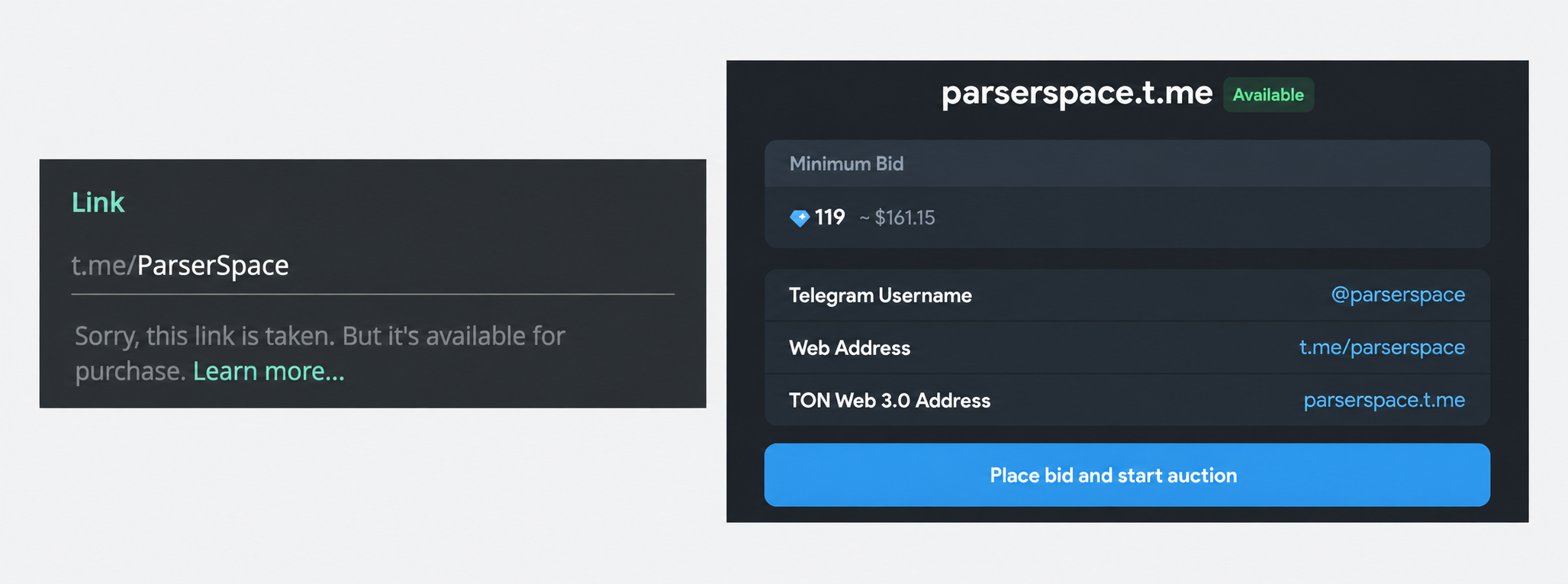
I had reserved that name for my own work. Now I was being asked to bid money to get it back, or leave it available for someone else to buy. That someone could be a scammer pretending to run my project. Protecting my users from that was the whole reason I had reserved the name.
To me, taking away a project’s address without warning and then putting a price on it is stealing. I had spent years working on the software. A quiet news channel didn’t mean I had stopped caring about the project or its name.
This was a decision Durov publicly supported. In August 2022, he confirmed that Telegram had taken addresses from channels that were empty or inactive for the previous year. He said 99% would gradually return to public use and proposed auctions for the most valuable short names. My project’s name ended up with a price attached to it.
In October, he announced Fragment with this promise.
“Finally people will have ownership over their social media addresses”
That makes me angry. I thought I already had my project’s address. Telegram took it away, then Durov presented paying for addresses as a way for us to own them.
Telegram’s FAQ says it can take back names from unused channels. But I was using that name to protect a project I was still developing. Imagine losing your website’s address because you hadn’t published a post for a year.
Then my channel’s earnings disappeared
I still had channels that had been running for years. When Telegram started sharing advertising income with channel owners, some of mine began earning TON. A few did well enough for the earnings to matter to me.
I didn’t need to withdraw anything, so I left the balances where they were. I checked them from time to time and assumed I could collect the earnings later. That was a huge mistake.
Recently, I opened MikrotikNews, the channel that had earned the most, and found that the Balance entry and Monetization tab were gone. I could no longer access the earnings I had left there.
The channel still had 2,465 subscribers. Another channel I own, GeForceNowGames, had 1,988 subscribers and still showed its balance and monetization controls.
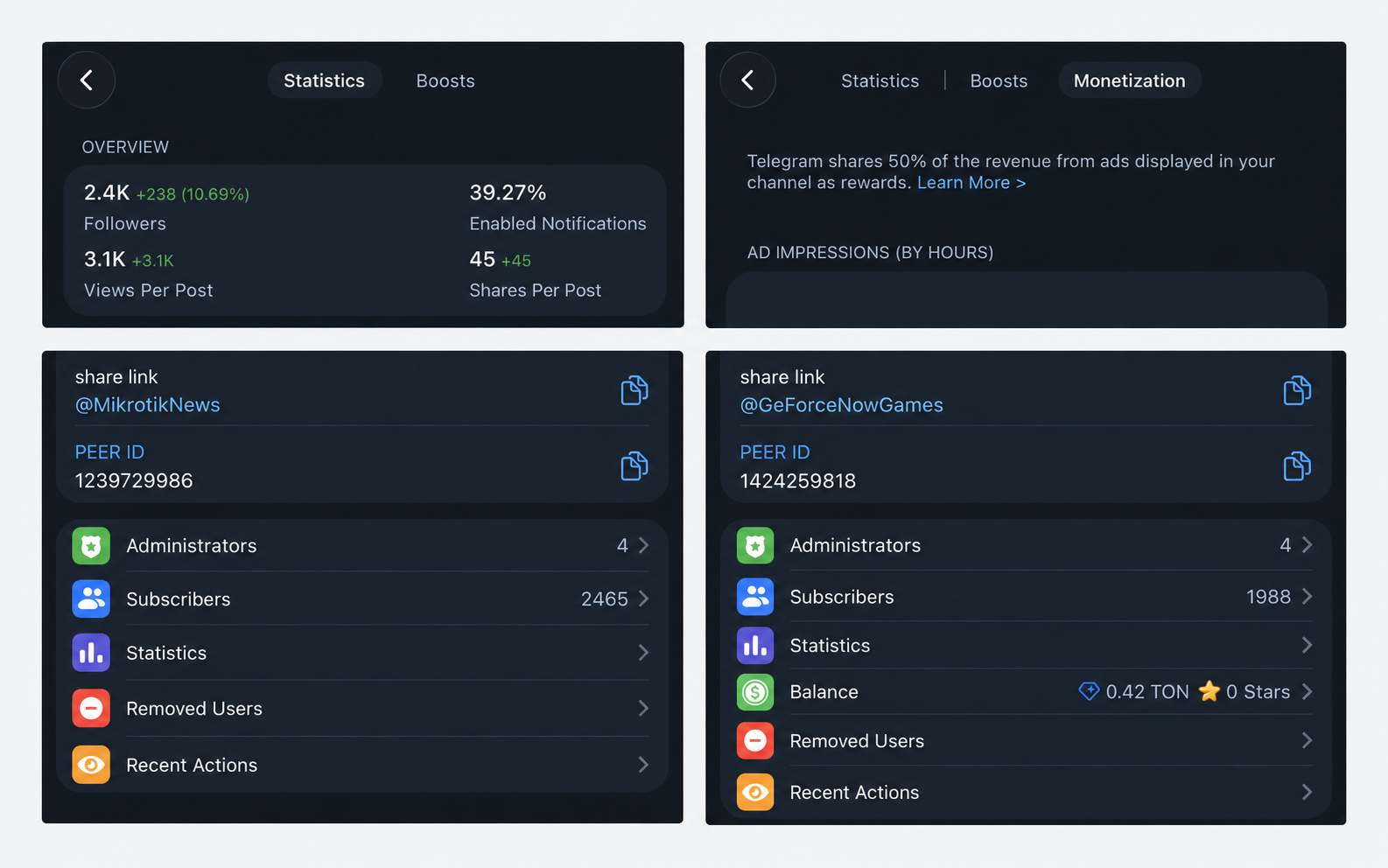
I don’t know what happened to the TON behind that missing screen. I lost access to it and couldn’t get an explanation.
I tried contacting Telegram through the app. It told me that support was handled by volunteers, which is also what its FAQ says. I tried every way I could find to contact support and never got an answer.
I have nothing against volunteers. But I needed someone at the company to look at my channel and tell me where my earnings had gone. As far as my problem was concerned, there was no support.
Other channel owners have been waiting too
I searched for similar cases and found them on Telegram’s own bug tracker.
A report from February 14, 2025 describes the advertising chart and withdrawal button disappearing across apps, despite earnings of more than 10 TON. The owner said repeated attempts to get help had gone unanswered. In a September 2025 follow-up, he said the problem had lasted more than a year without a response.
Another report from January 17, 2025 describes the TON section disappearing after a channel had earned 1.07 TON. Support later replied to this report, but the owner said he had already been waiting a year for the issue to be resolved.
There is also a report from July 11, 2024 about ads appearing in a channel while its monetization statistics stopped updating. That is a different problem from my missing controls, but it concerns the same earnings system. All three tickets were still marked Open when I checked in September 2026. The oldest had been open for more than two years.
Reading Telegram’s Content Creator Rewards Terms gave me less confidence, not more. The terms I read in September 2026 let Telegram change rewards and access to the program without warning or explaining why. They also say a pending balance isn’t money owned by me and held by Telegram. Rewards that haven’t been withdrawn can expire or be lost when the program ends.
I don’t know whether those rules explain what happened to my channel. I do know that leaving the earnings there meant trusting Telegram with something I couldn’t get back when I needed help.
I don’t trust Durov’s promises anymore
Before Telegram Premium launched, Durov promised in June 2022 that “all existing features remain free”.
But commenting in public groups as one of your channels was already a free feature. Telegram Desktop added it in December 2021. In September 2022, Telegram’s developers added a Premium restriction. The commit message says it directly.
“Restrict send from channels to premium in line with API restrictions.”
The reason I bring this up is the promise. Durov could have said that some free features might become paid later. Instead, he promised that existing features would stay free, and then one of them became paid a few months later.
People did object to these decisions. The Premium announcement has thousands of thumbs-down reactions. In August 2022, after Durov proposed the username auctions, Telegram Info reported that reactions were turned off in his channel following around 30,000 negative reactions. Nekogram reported the reactions being turned off too.
To me, disabling reactions after that response looked like hiding criticism. I can’t know his reason for doing it, but it gave me even less confidence that he wanted to listen to the people affected by his decisions.
When Durov breaks a clear promise like that, I have less reason to trust the next one. It makes me worry that he could come up with another reason to take something away from users, just as Telegram took my project’s username. I won’t build my business around hoping he won’t do it again.
I won’t pay Telegram to reserve my projects’ usernames or buy back the ones it took from me. I won’t promote my projects’ Telegram channels anywhere, either.
I can’t trust them with my work anymore
After my experience with Facebook and Telegram, I don’t trust either of them anymore. I’m angry and disappointed that companies I relied on could cause so much damage to my work and offer so little help.
I don’t understand why they care so little about projects that could bring them money through advertising. People building those projects are potential customers. But after everything that happened, it’s clear to me that my projects have no place on these platforms.
I’ll keep building my software and sharing news on my own website. I also need a way to reach my users directly, so I don’t lose contact with them like this again.
I hope my story helps someone else understand the risks before they trust Facebook or Telegram with their work and their subscribers.